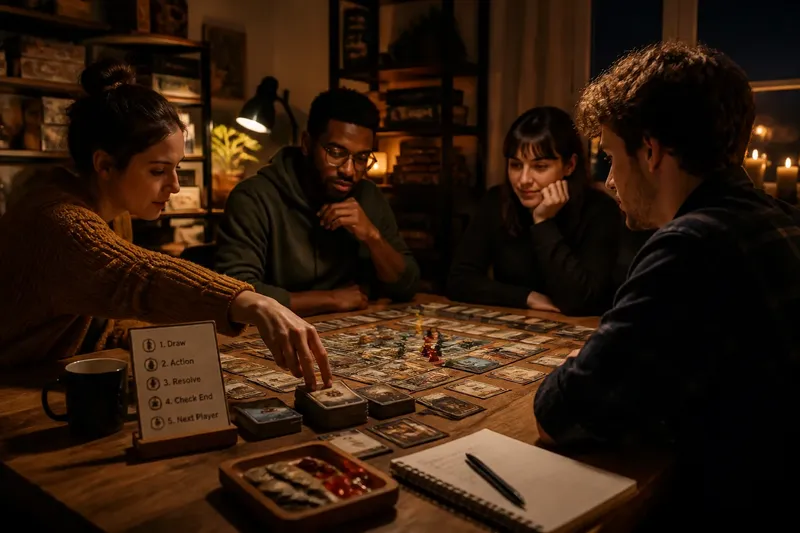
Your First Board-Game Evening, Without the Rules Lecture
Plan a first board-game evening with a short-to-learn game, a clear quick teach and room for questions, so newcomers can start playing without a rules lecture.
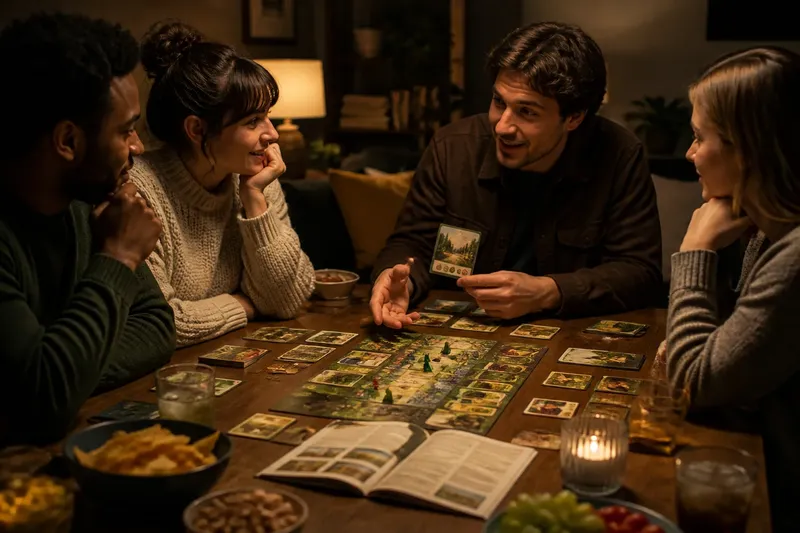
The snacks are on the table, someone has picked a game, and the rulebook is still open in the middle of the room. A first board-game evening can lose its easy mood before anyone takes a turn if the host tries to explain every exception up front. The better plan is to choose a short-to-learn game, teach only what players need to begin, and leave space for questions as they arise.
What makes a good first game for a mixed group?
Choose a game whose aim and turn are easy to demonstrate, and whose first round gives everyone something to do. A welcoming first game need not be childish or luck-free; it should simply let newcomers understand the basic choice in front of them without holding several rules in their heads at once.
Before inviting people, consider how the game behaves with the number of players you expect. A game that feels lively with a small table may become slow with a crowd, while a team game can give quieter guests a companion to consult. Read the player count and playing-time guidance on the box, then check that the game suits the group rather than assuming any popular title will fit.
Look for a clear objective, visible components, and turns that follow a repeated pattern. Cards with readable symbols, a board that makes progress obvious, or a shared task can all help. If the game relies on hidden information, bluffing, negotiation or a dense set of special abilities, ask whether that is the sort of social energy your guests would enjoy. None is a flaw; each asks more of a first-time player.
It can help to pick from a category guests already recognise. A word game may feel approachable to people who enjoy conversation; a tile-laying game may suit those who like spotting shapes; a cooperative game lets the table solve a puzzle together. Explain the choice in ordinary language when you invite people, so nobody arrives expecting a quiet puzzle and finds a loud contest instead.
How should you prepare before people arrive?
Learn the game well enough to play a sample turn and answer the obvious questions. You do not need to recite the rulebook. Find the sections on the goal, setup, turn order and ending, then note any rule that changes what a player can do. The rulebook stays nearby as a reference, not as tonight’s script.
Set the game out before guests arrive if the components are straightforward to organise. Sort cards or pieces into the piles the rules call for, check that the relevant tokens are present, and leave room for drinks away from the playing area. If setup has fiddly details, make a small reference note for yourself rather than asking new players to wait while you search through the box.
Think about the room as well as the game. Players should be able to see the board and each other, and anyone who needs glasses should have enough light to read cards. Keep chairs, snacks and spare space in mind; a crowded table can make even a simple game feel harder than it is. If someone arrives late, have a comfortable way for them to watch a round before joining, if the rules allow it.
Say you are inviting three friends who have not played the chosen card game before. You check that it supports the group, set out the starting cards, and keep the reference book beside you. When everyone arrives, you explain the shared aim and show one sample turn; the expected result is that guests can begin without waiting through a full reading, while the book is ready if an unusual question appears.
What belongs in a quick teach?
Start with the reason for playing: what players are trying to achieve, and what marks the end. Then show the pieces they will use, explain the order of a turn, and describe the main choice each player makes. A quick teach is not a race. It is a small map of the game, with enough detail to begin and no detour through rules nobody needs yet.
Use the actual components as you explain. Point to the board, hold up a card, or move a token through a sample action. A concrete demonstration is often easier to follow than a chain of terms such as “active player”, “discard pile” and “phase”. Name a term only when it helps, then show where it appears.
Cover any rule that could cause a frustrating surprise early on. If players may lose a turn, spend a limited resource, or be unable to undo an action, mention that before play begins. Explain the common action plainly and reserve rare exceptions for the moment they matter. Guests can ask about those exceptions; they do not need to memorise them in advance.
Try to keep the opening explanation interactive. Ask whether the goal is clear, invite someone to choose a sample move, and pause after the first round for questions. Avoid asking “Does everyone understand?” as if silence settles it. A specific prompt, such as “What could you do on your turn?”, gives people a low-pressure way to show what they have picked up.
How do you handle questions without losing the room?
Treat questions as part of the game night, not interruptions to it. If a player asks about a situation that has not happened yet, give the shortest useful answer and return to the current decision. If the answer depends on a rulebook detail, look it up together rather than bluffing; a calm pause is better than confidently teaching the wrong rule.
When a question touches a rare edge case, distinguish it from the basic turn. You might say, “That can happen later; for now, your options are these.” Then point to the relevant choices and let the player act. This keeps the table moving without making the question seem silly.
Some groups enjoy discussing a decision before making it; others prefer a brisk pace. Watch for signs that people want more room, such as a guest repeatedly asking what their choices are, or signs they are ready to get on with it, such as players reaching for their pieces. Adjust your explanations to the table, not to an imagined ideal of how quickly a game should be learned.
For a rule dispute, keep the tone light and consult the printed rules if the answer matters. If the wording remains unclear, the group can agree on a temporary interpretation for the current game and check the official source afterwards. Make the choice explicit so nobody feels that a quiet disagreement has decided the outcome.
What do new players usually want to know?
How long should the rules explanation take?
Keep it to the essentials needed for a first turn, then explain new details as they become relevant. The right length depends on the game and the group; a demonstration can make a slightly longer explanation easier to absorb than a fast list of rules.
Should you teach every rule before starting?
No. Explain the objective, turn structure, main choices and any important consequence players could not reasonably guess. Save uncommon situations and special cases for when they arise, with the rulebook close at hand.
What if someone is still confused after the first round?
Pause and restate the goal using the pieces on the table, then walk through one possible turn without rushing them. If the game remains uncomfortable, offer to finish the round together or switch to a simpler activity without making the guest feel responsible for the change.
Should the host play or teach from the sidelines?
For a small group, joining in can make the explanation feel like shared play rather than a lesson. If you are also learning the game, say so plainly and use the rules as a shared reference instead of presenting yourself as an authority.
How can the evening stay relaxed after the first game?
Let the first game end before deciding what comes next. Ask whether people would like another round, a different title, or a break; do not treat one game as a promise to spend the whole evening at the table. If the group wants to continue, choose based on the mood they have actually shown, not on a plan made before anyone arrived.
Keep the pace humane. A player who needs time to choose may be new to the game, or simply prefer to think aloud. Give them room without turning every turn into a coaching session. If someone asks for advice, offer a clear option and let them make the decision themselves.
It is not worth the effort to create a detailed teaching speech, memorise every obscure exception, or decorate the table as if it were a formal event. A cleared surface, a readable game and a host willing to pause are more useful than elaborate preparation. The point is to make it easy for people to take part, not to perform expertise.
For a first board-game evening, keep the game choice modest, the first explanation practical and the rulebook within reach. That small combination leaves room for the part a lecture cannot provide: players learning the rhythm together, one turn at a time.