From Parlour Cabinets to Pocket Collections
From parlour cabinets to pocket collections, learn how each format shapes what you keep, how you arrange it and when you choose to share it.
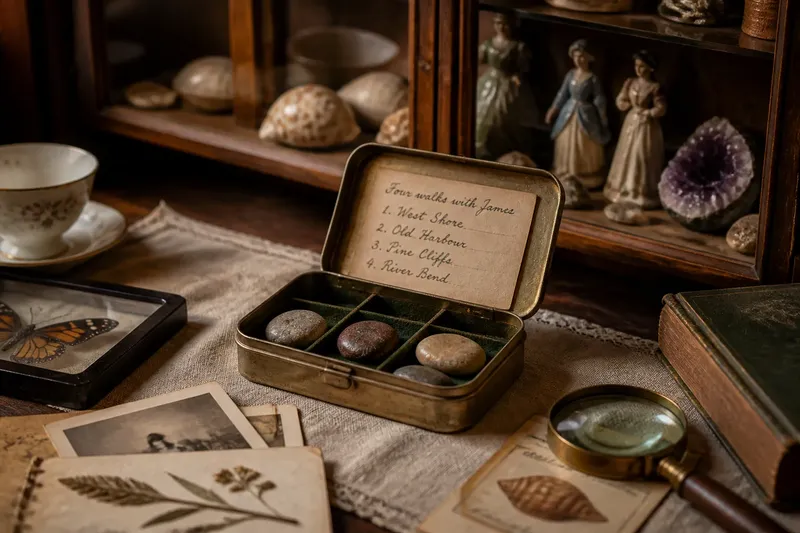
A guest pauses beside a glass-fronted cabinet; later, its owner chooses a few small keepsakes to carry in a tin. From parlour cabinets to pocket collections, these scenes show different ways of arranging and sharing treasured objects—not a proven, universal march from one format to the other.
Cabinets and portable cases have long offered distinct possibilities, but objects do not tell us exactly how every household used them or when one habit gave way to another. The more reliable comparison is practical: a cabinet makes a collection part of a room, while a small container lets its keeper decide when and where to bring it out.
What could a parlour cabinet show?
A cabinet gathered valued things into a deliberate view. Glass doors let visitors see shells, porcelain figures or polished stones while keeping them apart from casual handling. The arrangement could prompt a conversation: a guest might ask about a shell’s ridges or why a particular miniature had been given pride of place.
Placement shaped the encounter. In a room used to receive visitors, a cabinet made its contents available for looking and talking. Yet display did not necessarily reveal everything about the owner. A collection might reflect taste, memory or a subject of interest, but the objects alone cannot tell us which meaning mattered most.
Its arrangement also belonged to the room. Height, colour, spacing and repetition could link different objects into a composition, and the furniture held that composition in place. Anyone entering the room encountered the display from much the same vantage point.
How did portable collections differ?
Boxes, cases, albums and envelopes can keep small objects together without tying them to one room. A stamp album, coin purse or shell box can be brought to a table or kept out of sight. Portability creates the option of sharing a collection elsewhere, but it does not mean the owner always wanted an audience.
A small container also encourages selection. Its keeper may choose a few objects to carry, organise them around a theme or memory, and change the selection as interests shift. A photograph or note can stand in for an awkward object when the original is not convenient to move.
Neither format is automatically more intimate or more public. A cabinet may hold private associations; a pocket album may be passed around a gathering. The difference is in the opportunities each creates: furniture makes a collection part of a room, while a portable container lets its keeper choose when to reveal it.
What does the container tell you about showing?
Look at how a container presents its contents. A glass-fronted case invites viewing without touch. A hinged box creates a reveal when opened. An album presents objects in sequence, while a clear sleeve can protect an item and keep it visible. Each format offers a different balance of access, arrangement and control.
A cabinet presents a group at once; an album lets someone turn from one page to the next. A divided tin can keep pieces apart, while loose objects are easy to rearrange but also easier to scatter. These are possibilities, not fixed rules: a keeper can use a cabinet for private pleasure or open a pocket case for friends.
Imagine a collector with four smooth beach pebbles, each linked to a different walk with a friend. They place the pebbles in a divided tin, write the walk locations on a small card, and keep both together. The result is a portable group whose labels preserve the sequence; at tea, the collector can open the tin and share one pebble’s story, rather than presenting all four as room décor. The quantities and details in this example are invented.
How can you arrange a small collection simply?
Begin with what someone should notice. A row of similar objects can make small differences clearer; grouping by colour or material can show a pattern. A backing card or shallow tray may be enough to give the arrangement a clear shape.
- Check the viewing distance. If details are hard to see from where people stand, bring the display closer or add a simple label; if the shapes read clearly already, leave the arrangement where it is.
- Check what connects the objects. If they share a material, theme or memory, group them to make that link visible; if no link is useful to viewers, arrange them by shape or keep them in separate groups.
- Check how often people handle them. If visitors are likely to pick up sturdy objects, use a box or tray; if an item is fragile, keep it protected and offer a photograph or description instead.
- Check whether there is room for additions. If the display is crowded, move some pieces to a labelled box or album; if space remains, leave it open for a future change.
- Check whether an object needs context. If its significance is not obvious, add a brief note or dated envelope; if the story is clear to the intended viewer, skip the label.
- Check whether the container suits the objects. If pieces are flat, an album may keep them in order; if they are sturdy and small, a case may be easier to carry; if neither fits their care needs, seek suitable storage advice.
Elaborate display furniture is not worth the effort before you know how the collection is used. If sorting and handling bring the pleasure, a locked cabinet may make access less convenient; if the objects are best viewed together and left undisturbed, a stable display may suit them. Let the habit, not the ornament, guide the choice.
Which objects suit cabinets, albums or pockets?
A cabinet can suit objects that benefit from a stable arrangement and can be appreciated at a glance. Albums are natural companions for flat items such as postcards, pressed leaves or paper ephemera, where order and comparison matter. Pockets and small cases suit sturdy pieces that can travel without special handling.
The material matters as much as the format. Paper can crease, metal can tarnish, and delicate natural specimens may be harmed by frequent handling. For valuable, fragile or potentially hazardous objects, follow appropriate care advice; ask a qualified conservator if you are uncertain about preservation or cleaning.
Some collections invite a keeper to fill gaps in a series; others remain open-ended. A cabinet can make a group look settled, while a notebook or portable case can leave room for new discoveries. Neither arrangement needs to declare the collecting finished.
What should you know about choosing a collection format?
Should I display every object I own?
No. A selected group may be easier to view, while the rest can stay in a labelled box or album for rotation. Keeping some pieces out of sight is a way to shape attention, not a judgement on them.
Is a pocket collection still a collection if nobody else sees it?
Yes. Sorting, remembering and revisiting objects can be satisfying without an audience. Sharing is one possible part of collecting, not its sole purpose.
How can I make a display easy to update?
Choose a tray, shallow box or album with room to rearrange pieces. If you add something, you can shift the layout without rebuilding the whole display.
What if one object is too fragile to handle?
Keep it in a stable, protected place and use a photograph or written note when you want to share its story. If its care needs are uncertain, ask a qualified conservator rather than experimenting with cleaning methods.
What changed when collections could travel?
A parlour cabinet made collecting part of a household setting; a pocket collection made it possible to carry a chosen group beyond that room. Those options can coexist: someone may keep a larger group at home and bring a few pieces along for a particular walk or conversation.
From parlour cabinets to pocket collections, the useful story is not a simple historical handover but a change in the possibilities of display. A room-bound arrangement asks visitors to come to the objects; a portable one lets its keeper bring them to a person or place. When choosing how to keep a collection, consider who should see it, when, and on whose terms.