Sketchbook or Loose Sheets for Drawing Away from Home?
Sketchbook or loose sheets? Compare portability, page choice and sorting to choose a drawing format that suits your outings and keeps work easy to manage.
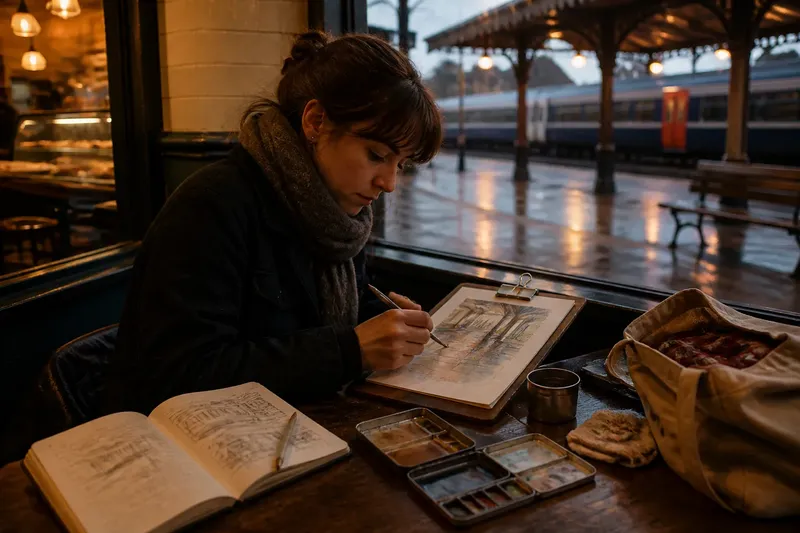
Mara is packing for an afternoon at the railway station: a pencil, a small tin of watercolours and room in her tote for lunch. Her sketchbook is tidy but offers paper she cannot choose; loose sheets promise more choice but might buckle or vanish. For drawing away from home, the decision is less about which format is better in general than what she wants to draw, carry and keep.
What does Mara want from the outing?
Imagine Mara has two aims: make quick pencil sketches of passing trains and paint a few colour studies of the station’s tiled floor. She expects to move between a bench and the café, and does not want a rigid board taking up space. This gives her a useful test: the format has to open comfortably, suit both dry and wet media, and leave her able to identify each drawing later.
A bound sketchbook makes a ready-made drawing surface. Its covers protect the pages, and the binding keeps a sequence together. Loose sheets are more adaptable: Mara can choose paper for each medium, take only what she needs, and separate studies from finished work. But each sheet needs its own support and a plan for staying clean.
Which format is easier to carry?
For Mara’s first stop, the sketchbook wins on convenience. She can slide it into her tote without adding a folder, and its covers shield the paper from crumbs and pencil smudges. On a crowded train, it is also easier to hold a book than to keep a sheet and drawing board balanced on her knees.
Loose paper need not mean a large, unwieldy bundle. Mara could carry a few sheets inside a stiff folder, with a lightweight drawing board behind them. That takes more room than a slim book, but it lets her select a smaller working sheet and leave the rest at home. A folder with a pocket can hold completed drawings apart from clean paper.
There is a trade-off in how each format sits while drawing. A sketchbook can be propped open, though a new book may resist lying flat; clips or an elastic band can help hold a page. A loose sheet lies flat when clipped to a board, which is useful for watercolour, but the board adds bulk. For short pencil sketches in a tight seat, the book is likely to feel simpler. For painting at a table, the supported sheet may be more comfortable.
How much control does she need over the paper?
Mara’s sketchbook pages are suitable for pencil, but she is unsure how they will handle watercolour. A book is convenient only if its paper suits the materials she plans to use. She can check the paper description and maker’s instructions, then consider whether the surface and weight match her intended medium. Paper sold for watercolour is generally designed to cope better with water than ordinary drawing paper, though the feel and handling vary.
With loose sheets, Mara can pack a few different papers: smooth sheets for fine pencil detail and textured watercolour paper for colour studies. She can also choose a larger sheet and crop or fold it to suit a particular view. That choice is valuable when an outing has a clear material experiment in mind.
The freedom has a small cost: paper choice can become its own distraction. Mara does not need to carry a sample pack for every possible idea. If she wants to spend the afternoon observing rather than comparing surfaces, one reliable sketchbook—or a small set of sheets already chosen for the day—will do.
What will make the drawings easier to sort?
A sketchbook keeps work in sequence. Mara can date a page, jot down the station or weather, and later see how one observation led to another. That continuity suits people who enjoy browsing a record of their outings. The downside is that an awkward or unsuccessful sketch stays among the pages unless she tears it out, which may damage the binding or leave an uneven stub.
Loose sheets make sorting more direct. Mara can label the back with a date and place, then group pencil studies, colour tests and pieces to frame in separate folders. She can give away or display a drawing without removing it from a book. Yet an unlabelled sheet can become a mystery, and a pile in a tote can acquire bent corners or smudged neighbours.
For her station trip, Mara decides to take a small sketchbook for the train sketches and two watercolour sheets in a folder. She clips one sheet to a board at the café, then writes the place and date on the back when it is dry. The result is a continuous notebook record alongside a couple of paper studies she can store separately. The useful lesson is not that every outing needs both formats; it is that a mixed kit can be modest when each item has a specific job.
Which small questions should settle the choice?
Is a sketchbook better for drawing on a train?
Often, yes, if the drawing is small and the journey is crowded. A book gives the paper a backing and keeps loose pages from shifting, though a compact board and clipped sheet can suit someone who needs a flatter surface.
Can loose sheets work for a casual sketching trip?
They can, especially when the paper needs to suit a particular medium or the drawings will be sorted individually. Carry only the sheets you expect to use, inside a folder that protects both clean and finished work.
How can a sketchbook handle watercolour?
Choose a book with paper intended for water-based work and consider how much water your approach uses. A book’s paper and binding affect how it handles, so check the product details rather than assuming every sketchbook behaves alike.
How should loose drawings be labelled?
Write a short note on the back once the page is dry: date, place and perhaps the medium or subject. Keep clean sheets and completed work in separate parts of a folder to reduce confusion and smudging.
What should Mara pack next time?
After the outing, Mara notices that she reached for the sketchbook whenever she had only a moment, but used the loose sheet when she wanted to adjust the composition at a table. For another quick walk, she may carry only the book. If she plans a watercolour session, she can bring a folder and board instead.
That is a practical way to choose a sketchbook or loose sheets for drawing away from home: start with the conditions of the outing, then match the paper and carrying method to the work. A book favours protection and continuity; loose sheets favour paper choice and easy sorting. The best format is the one that lets the drawing begin without making the kit feel like the main event.