The Finished-Project Myth: Why Practice Can Be the Point
Process-led hobby goals make practice enjoyable without demanding a polished result, so you can spend your free time learning, experimenting and stopping gladly.
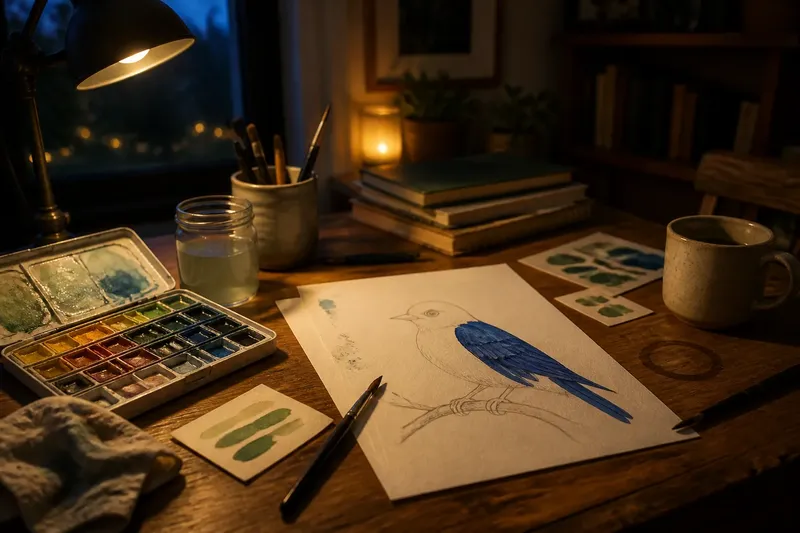
The half-painted bird on the kitchen table has one blue wing, a pencilled eye and a mug ring beside it. If you judge the evening by whether the bird is finished, it looks like a failure. If you judge it by the pleasure of mixing colour and learning how a small brush behaves, it has already earned its place. Process-led hobby goals make that second kind of progress easier to recognise.
The finished-project myth says a pastime matters most when it produces something complete, impressive or ready to show. That can turn a hobby into another queue of obligations. A gentler approach is to choose what you want to practise, notice what holds your attention and let completion remain an option rather than a verdict.
What do you want from this session?
Before gathering materials, choose a quality of attention rather than a final object. You might want to work slowly, try a technique, enjoy repetition or make a little room for surprise. That intention gives a session shape without requiring it to end in a finished thing.
Keep the aim small enough to remember while you work. “Explore warm colours” is easier to carry than “become better at painting”. “Listen for the bass line” suits a guitar practice session better than “learn a song by Friday”. The aim is not a performance target in disguise; it is a prompt for what to notice.
For a hands-on pastime, put out only what serves that intention. If you want to explore texture, set out scrap paper, a graphite pencil and a soft cloth. If you want to enjoy the feel of clay, prepare a modest lump and a damp sponge rather than planning a finished vase. A smaller setup can make starting feel less like signing a contract.
How can you begin without creating a deadline?
Make a first move that is easy to reverse. Draw a few marks on scrap paper, play a phrase slowly, fold test shapes from spare card or knead the clay without choosing a final form. These beginnings invite curiosity because they do not force an early commitment to a design.
Then work in short, natural passes. A pass might mean drawing until a shape begins to feel familiar, playing a phrase until your hands relax, or trying several paper folds to see which one catches your eye. There is no need to set a timer unless a time limit genuinely makes the session easier to enter.
Imagine you have a quiet evening and a new watercolour set, but no appetite for a full picture. You decide to see how two greens behave beside one another, brush a few loose leaf shapes on a scrap sheet and notice that a dry brush leaves a pleasing broken edge. The paper is not a finished painting; the session still offers a clear experience to remember and a technique you may want to revisit.
What counts as progress when nothing is finished?
Process-led progress often appears as a change in what you can notice or choose. You may recognise when a pencil is too soft for a particular mark, hear where a melody loses its pulse, or discover that you prefer making small paper models to large ones. Those observations can guide the next session without needing to become a formal record.
Give yourself a simple way to capture what mattered. Write one sentence on a scrap of paper, leave a note in the project box, or take a private photograph if seeing the arrangement helps you resume. Keep it specific: “The heavier pencil made the shadow muddy” is more useful than “I should improve”. Recording is optional; it should support the pastime, not become a new pastime you feel obliged to maintain.
It can also help to separate practice from display. A sketch made to test movement does not need careful shading; a knitted swatch can teach you about tension without becoming a scarf; a tune played for its rhythm need not be performed for anyone. When every experiment is treated as a candidate for an audience, the safest choice is often not to experiment at all.
How do you stop without feeling you have failed?
Choose a natural stopping cue before the session gets tangled in self-criticism. You could stop when you have explored one material, when your attention starts to drift, or when you have found one detail worth carrying forward. A stopping cue is not a quota. It simply gives you permission to put the work down before fatigue turns play into a chore.
Leave the materials in a state that welcomes a return. Put loose pieces in a tin, slide paper into a folder or set the instrument somewhere it can be picked up safely. If the work itself is fragile, a shallow tray or a labelled box can keep it undisturbed. The aim is to make re-entry less fussy, not to preserve a perfect studio scene.
When you return, you do not have to continue where you left off. You can repeat the same exercise, change one material or follow a new curiosity. A hobby is allowed to wander; consistency need not mean marching towards a single finished object.
What if you do want to finish something?
Completion can be satisfying, and there is no need to reject it to escape the finished-project myth. The useful distinction is whether finishing serves your interest or has become the only proof that your time counted. You might complete a small object because you enjoy the final decisions, while keeping other sessions open-ended.
If a project starts to feel heavy, make its scope smaller rather than forcing yourself through the original plan. A long drawing might become one studied corner; a complicated sewing idea might become a sample seam; a set of songs might become a single phrase played for pleasure. A reduced project is not a lesser pastime if it better fits the energy you have.
It is not worth spending an evening inventing a complicated scoring system for every hobby session. A note about what felt absorbing, awkward or surprising is usually enough. The point is to make room for attention, not to grade your leisure with the same machinery you might use at work.
Which process-led hobby goals are worth trying?
Can I practise without choosing a finished project?
Yes. Pick one action, such as testing charcoal pressure or repeating a chord change, and let the session centre on that. You can stop when the action has held your interest for long enough, even if no object or performance emerges.
How do I know whether a pastime is still enjoyable?
Notice what you look forward to, what absorbs you and what leaves you curious afterwards. If an activity feels persistently burdensome, you can change its scale, materials or frequency rather than treating your reluctance as a character flaw.
Should I keep every unfinished piece?
No. Keep pieces that help you resume, show a technique you want to remember or simply please you to see. Recycle or set aside the rest; unfinished work does not acquire special value merely by remaining unfinished.
What if I keep comparing my practice with polished work?
Choose a reference that helps with one concrete question, such as how a fold holds its shape, and then return to your own materials. Comparing your experiments with someone else’s finished display can obscure the different purpose of each.
How can you make room for practice next time?
At the end, leave yourself a small invitation: a tool ready to pick up, a note about a colour combination or a page marked at the phrase you want to play again. Then let the session be complete in its own way, even if the project is not. Process-led hobby goals are most useful when they help you choose the next enjoyable action, not when they turn enjoyment into another thing to finish.